Showing posts with label Mix Species. Show all posts

Monday, November 16, 2009

The Bronze-winged Parrot is a medium sized pionus parrot 28 cm (11 in) long. It is a short-tailed stocky parrot found in forest and woodland in north-western South America.

Description

It is mainly dark with a whitish chin patch and its upper chest is speckled with pink feathers. It has short red undertail feathers. The rump, tail and wings are dark blue with lighter blue underwings. The head is dark blue-green; the mantle, back and underparts are dark bronze-green with some blue tipped feathers and sometimes scattered red feathers. Its beak is pale yellow. In adults the ring of bare skin around the eyes is pink. Juveniles have whitish eyerings and their underparts are brownish.

Taxonomy

Today most authorities consider this species as monotypic, but some continue to recognize two subspecies:

  • P. c. chalcopterus: west Venezula, and north and central Colombia.
  • P. b. cyanescens: south-west Colombia, west Ecuador, and north-west Peru. Reputedly with broader blue margins on feathers, chin patch and surrounding ring smaller and less distinct.

Range and habitat

The Bronze-winged Parrot is found in far western Venezuela, western and central Colombia, western Ecuador and far north-western Peru. In Venezuela it mainly occurs at altitudes of 900-1400 m, in Colombia it mainly occurs at altitudes of 1400-2400 m (occasionally as high as 2800 m), in Ecuador mainly below 1400 m, and in Peru below 800 m. It generally prefers the canopy of forest and woodland (both humid and semi-deciduous), but also occurs in adjacent habitats with tall trees. It appears to be rather nomadic in parts of its range, but the movements (possibly only in response to the availability of food) are generally poorly understood.


Behavior

It is typically seen in pairs of small groups of up to ten birds.

The Bronze-winged Parrot nests in tree cavities. The eggs are white and there are usually three to four in a clutch. The female incubates the eggs for about 26 days and the chicks leave the nest about 70 days after hatching.

The White-crowned Parrot, also known as the White-crowned Pionus in aviculture, is a small parrot which is a resident breeding species from eastern Mexico to western Panama.

It is found in lowlands and foothills locally up to 1600 m altitude in forest canopy and edges, and adjacent semi-open woodland and second growth. The 3-6 white eggs are laid in an unlined nest, usually a natural cavity in a tree or a hollow palm stub.

The White-crowned Parrot is 24 cm long and weighs 220 g. The adult male has a white forehead and crown, the feature which, likened to an old man’s white hair, gave rise to the specific name senilis. The throat is white, and the rest of the head, neck and breast are dull dark blue. The belly is light green, and the upperparts are dark green, with a yellow-olive shoulder patch. In flight, the blue underwings and red vent are conspicuous features.

The female White-crowned Parrot is similar to the male, but the blue plumage fades into scaling on the lower breast and the shoulder patch is duller. Young birds have little blue on the head and neck or red on the undertail, and the crown feathers are green edged with white.

The White-crowned Parrot feeds in social flocks of 30-50 birds, which may wander outside the breeding range once nesting has finished. It feeds on taking various seeds, nuts and fruits, and can be pest in crops of corn or sorghum, and commercial fruit plantations.

It can be unobtrusive when feeding since it is slow-moving, usually silent, and keeps in the canopy. However, at rest it often perches conspicuously at the top of an unopened palm frond.

The Scaly-headed Parrot is a species of bird in the Psittacidae family, the true parrots. It is also called Scaly-headed Pionus, Maximilian Pionus, Maximilian Parrot, Maximilian's Pionus, or Maximilian's Parrot.

It is found in eastern Brazil, central and eastern Bolivia, Paraguay, and northern Argentina. It is found in a wide range of wooded habitats, from humid subtropical forest to arid Caatinga. It is remains fairly common throughout a large part of its range. It is typically seen in pairs or small flocks. The scaling to the head for which it is named is typically far less distinct than the bright red undertail coverts (a feature found in all members of the genus Pionus).

The Red-billed Parrot or Red-billed Pionus is a species of parrot in the Psittacidae family. It is found in humid subtropical forests in the Venezuelan Coastal Range, Sierra Nevada de Santa Marta, and in the Andes from Colombia in north to Bolivia in south (though with significant gaps). Uniquely for a member of the genus Pionus, its bill is almost entirely bright red. The plumage is greenish with a dull blue chest and red undertail coverts.

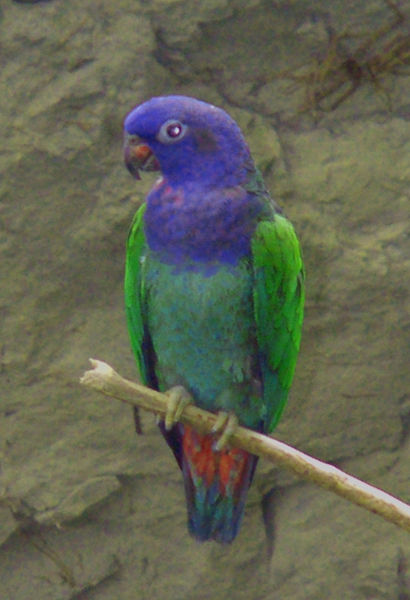
The Blue-headed Parrot, also known as the Blue-headed Pionus, Pionus menstruus, is a medium large parrot. It is about 27 cm long and they are mainly green with a blue head and neck, and red under tail feathers. It is a resident bird in tropical and subtropical South America and southern Central America, from Costa Rica, Venezuela and Trinidad south to Bolivia and Brazil. It is named for its medium-blue head and neck.

Its habitat is forest and semi-open country, including cultivated areas. It is largely restricted to humid or semi-humid regions, but locally extends into drier habitats, at least along rivers. The Blue-headed Parrot lays three to five white eggs in a tree cavity.

Blue-headed Parrots are noisy birds and make light, high-pitched squeaking sweenk calls. They eat fruit and seeds, and sometimes grain. They roost communally in palm and other trees, and large numbers can be seen at the roost sites at dawn and dusk.

Blue-headed Pionus parrots are popular as pets. Compared to other parrot species (Amazons for example) they are very quiet. They are affectionate, but not known for their talking ability.

Description

The Blue-headed Parrot is about 28 cm (11 in) long and weighs 245 gm. It is mainly green with a blue head, neck and upper breast, red undertail coverts, and some yellowish on the wing coverts. The upper mandible is black with reddish areas on both sides. They have dark ear patches. In addition to the well-known nominate subspecies found throughout most of the species' South American range, there are two more localized subspecies: rubrigularis from southern Central America and the Chocó has an overall paler plumage and typically a relatively distinct pinkish patch on the throat, and reichenowi from the Atlantic Forest in east Brazil has a paler bill and most of the underparts blue. In all subspecies the male and the female are alike, and juvenile birds have less blue on the head, as well as red or pinkish feathers around the ceres. They moult into their adult plumage at about 8 months of age, but it can take up to two years for the full blue hood to emerge.

Range

In South America, the Blue-headed Parrot is mainly an Amazonian species, including in the southeast the neighboring Araguaia-Tocantins River system as its eastern limit; a disjunct population lives southeastwards on Brazil's South Atlantic coast, a coastal strip from Pernambuco in the north to Espírito Santo state in the south, about 1500 km long. In northwest South America the range continues into Central American Panama to Costa Rica. It avoids the northern Andes cordillera spine, and a smaller contiguous area of central Venezuela and northern Colombia. A Pacific Ocean coastal strip continues the range, from southern Ecuador, north to Caribbean areas of northwestern Colombia and western Venezuela.

Behaviour

Food and feeding

They eat fruit and seeds, and sometimes grain.

Breeding

The Blue-headed Parrot nests in tree cavities. The eggs are white and there are usually three to five in a clutch. The female incubates the eggs for about 26 days and the chicks leave the nest about 70 days after hatching.

The Yellow-faced Parrot, also known as the Yellow-faced Amazon, is the only species of the genus Alipiopsitta. It is a semi-nomadic species found in the cerrado region of Brazil and adjacent Bolivia. It occurs in small numbers and is declining or has already disappeared in large areas of its former range.

Previously, it was placed within the genus Amazona, but recent research showed that this species is much more closely related to the Short-tailed Parrot (Graydidascalus brachyurus) and to the members of the genus Pionus. Following this discovery, it was briefly placed in the genus Salvatoria, until this name was found to be pre-occupied by a group of polychaete worms from the superfamily Nereidoidea, thus leading to the transferral of the Yellow-faced Parrot to the genus Alipiopsitta.
The Short-tailed Parrot is the only species of the genus Graydidascalus. It is found along both banks of the Amazon river and other major Amazonian rivers in Brazil, Colombia, Ecuador and Peru. As suggested by its range, it is associated with the specific forest and woodland types growing near major rivers, although it also extends into the coastal deltas of French Guiana and Amapá, Brazil.

The closest relative is the Yellow-faced Parrot (Alipiopsitta xanthops) and the members of the genus Pionus.

It has a total length of c. 24 cm (9½ in). It is overall green with a large dark bill (large even for a parrot) and, as suggested by its name, a very short tail. Adults show a small maroon-red spot on the shoulder and at the base of the outer tail-feathers, but typically neither are easy to see.

The species is considered safe at the moment.

Sunday, November 15, 2009

The Pileated Parrot, also known as the Red-capped Parrot (leading to easy confusion with the Australia Purpureicephalus spurius), is a medium-small species of parrot with a total length of about 22 cm (8½ in). It is found in or near Atlantic Forest in south-eastern Brazil, far north-eastern Argentina, and eastern Paraguay. A local name in Paraguayan Guaraní is Cúiu Cúiu.

Unlike all other species previously placed in the genus Pionopsitta, the Pileated Parrot does not have a contrasting brownish-olive chest, and recently it was established via mtDNA that it is indeed distinct enough for the others to be moved into a separate genus, Pyrilia, again making Pionopsitta monotypic. The plumage of the Pileated Parrot is overall green with bluish flight feathers, a faint brownish-maroon auricular patch (lacking in juveniles) and, in the male, a bright red forehead that extends down to just below the eyes.
The Orange-cheeked Parrot is a species of parrot in the family Psittacidae. It was formerly placed in the genus Pionopsitta which is now monotypic. It is found in the Amazonian Andes, in humid lowland forests in the northwestern, southwestern and south-central Amazon Basin in South America. The binomial name of this bird commemorates the French painter Jacques Barraband.

The Red-fan Parrot, also known as the Hawk-headed Parrot, is an unusual New World parrot hailing from the Amazon Rainforest. It is the only member of the genus Deroptyus.

The Red-fan Parrot possesses elongated neck feathers that can be raised to form an elaborate fan, which greatly increases the bird's apparent size, and is possibly used when threatened. It generally lives in undisturbed forest, feeding in the canopy on fruits. It nests in holes in trees and stumps, laying two to three eggs. Only two nests have been examined in the wild, both had one chick.

It is not considered threatened, but is listed on CITES Appendix II (as are most parrots not listed on Appendix I).

Aviculture

Red-fan Parrots, although not particularly common in aviculture are sometimes kept as aviary birds or companion parrots. Whilst juvenile birds tend to be docile, adults can be particularly ill-tempered, stubborn, unpredictable and strong-willed birds, showing extreme aggression towards humans and other birds housed with them (including others of their own species and/or their own mates), particularly when in breeding condition. Red-fan Parrots, when kept as pets tend to bond with one person and require firm handling and a patient owner, experienced in both bird-keeping and the reading of psittacine body language. However as with all parrots, temperament can vary greatly from individual to individual and some Red-fan Parrots do make excellent companions.


The White-bellied Parrot, in aviculture often referred to as the White-bellied Caique, is one of the two species in the genus Pionites of the Psittacidae family; the other species being the allopatric Black-headed Parrot. Both species are popular as pets.

It is found in humid forest and nearby wooded habitats in the Amazon south of the Amazon River in Bolivia, Brazil, and Peru. It is generally fairly common throughout its range and is easily seen in a wide range of protected areas, such as the Manú National Park and Tambopata-Candamo in Peru, Cristalino State Park (near Alta Floresta), Xingu National Park and Amazônia National Park in Brazil, and Madidi National Park in Bolivia.

Description

The White-bellied Parrot has an orange-yellow head and vent, a white belly, green wings and back, bluish primary feathers, a pinkish-horn beak, and pinkish legs and feet. Juveniles have brownish or black feathers on the head and nape, yellow feathers on the white belly, and greyish legs. Generally, the off-colored feathers will be lost and replaced by orange or white feathers respectively as the bird matures. Young birds also have dark brown irises, which will change to a rust or orange with age.

Subspecies

  • Green-thighed Parrot/Caique (Pionites leucogaster leucogaster). Found in the eastern part of its range. It has green thighs and upper tail.
  • Yellow-thighed Parrot/Caique (P. l. xanthomerius). Found in western part of its range. It has yellow thighs and green upper tail.
  • Yellow-tailed Parrot/Caique (P. l. xanthurus). Found in the central part of its range. It has yellow thighs and upper tail.

The Yellow-thighed is the subspecies most commonly kept as a pet in the United States. The Green-thighed is somewhat rare in captivity, and Yellow-tailed is very rare in captivity.

The Black-headed Parrot, also known as the Black-headed Caique, Black-capped Parrot or Pallid Parrot, is one of the two species in the genus Pionites of the Psittacidae family; the other species being the allopatric White-bellied Parrot.

It is found in forest (especially, but not exclusively, humid) and nearby wooded habitats in the Amazon north of the Amazon River and west of the Ucayali River in Brazil, Colombia, Ecuador, French Guiana, Guyana, Peru, Suriname, and Venezuela. It is generally fairly common and occurs in many protected areas throughout its range.

It is most often found in pairs or small noisy flocks of up to 10 individuals, but sometimes up to 30. In the wild, they eat mostly flowers, pulp, and seeds and possibly insects.

Description

The Black-headed Parrot is a medium-small, short-tailed parrot with a black crown, yellow to orange head, whitish belly, yellow thighs and crissum, green back, wings and upper tail, blue primaries (blackish from below), and greyish-black bill and feet.

Male and female birds have identical plumage.

Aviculture

Black-headed Parrots are popular in aviculture. The only ways to determine gender of an individual Black-headed Parrot are surgical sexing and DNA sexing. DNA sexing is safer for the bird than surgical sexing.

Black-headed Caiques are very energetic pets. They need a large cage with lots of toys and perches (they tend to hop more than fly). Cage minimum should be 24" L X 24" W X 36" H, though the larger the better. Maximum bar spacing is 1".

Caiques can be nippy, so setting rules and boundaries early is best. although be prepared for a bird who uses its beak more often than other parrot species.

Thursday, November 12, 2009

The Maroon-fronted Parrot is a large, macaw-like parrot. It is dark green with a dark red shoulder and a maroon forehead and eye-stripe. Its underside of the wings and tail appear to be black when it is in flight. It makes a high, rolling cr-a ak sound. Groups sound similar to the Acorn Woodpecker if they are heard from a distance.

The species is endemic to northeast Mexico, where only about 2500–3000 birds survive in the wild.

Description

The Maroon-fronted Parrot is a large mostly green parrot about 45 cm (18 in) long. The adults have a dark maroon brow which extends over the rim of bare yellow skin that surrounds the eyes. They have a brighter red at the bend of the wing. The tail is long and pointed. The underside of the wings are blackish. The juvenile has a pale beak, whitish eye-rings, and lack the dark maroon stripe over each eye.

Habitat

Maroon-fronted Parrots live in mature pine, mixed conifer, and pine-oak forests from 2000 to 3500 meters. This bird is endemic to the Sierra Madre Oriental in Nuevo León, Coahuila and Tamaulipas, Mexico.

Behaviour

They nest in limestone cliffs near moving water in large colonies. Breeding coincides with the fruition of pines, which is its main food source. They lay one to three eggs in July and the juveniles fledge around November. They migrate over short distances seasonally.

Status and conservation

This bird is considered vulnerable due to overgrazing and habitat destruction. It is estimated that only 2500–3000 birds remain, while 95 to 110 young are produced in a year.

The ITESM Campus Monterrey carry out environmental education programs and science research in Parque Nacional Cumbres de Monterrey and Sierra de Arteaga for the conservation of Maroon-fronted Parrots.

The Thick-billed Parrot, Rhynchopsitta pachyrhyncha is an endangered, medium-sized, up to 38cm long, bright green parrot with a large black bill and a red forecrown, shoulder and thighs. It is found in Mexico, and its former range extended marginally into the United States.

Description

The Thick-billed Parrot is a medium-sized, up to 38 cm (15 in) long, bright green parrot with a large black bill and a red forecrown, shoulder and thighs. Adult eyes are amber, while juveniles have brown eyes. The rest of the bird is bright green. Thick-billed Parrots show red shoulders and leading edge on the underwing, followed by a blackish green stripe, then a yellow stripe, followed by the remaining underwing showing dark green. It appears to show a blackish tail.

Distribution and habitat

The Thick-billed Parrot lives in temperate conifer, pine, mature pine-oak and fir forests from 1200 to 3600 meters. For the most part, it is restricted to the Sierra Madre Occidental of Mexico, though it used to live in the southwestern United States.

Behaviour

The Thick-billed Parrot likes to nest in tree cavities, especially old woodpecker holes. It mainly feeds on seeds from various pine species, so much so their entire lives revolve around cone production. Flocks of these parrots roost by cliffs and they breed at the peak of pine seed production. It is nomadic, following the variations of cone abundance. The bird sounds like a high pitched macaw and makes a variety of harsh, rolling calls. They are adept fliers.

Status

Habitat destruction and illegal bird trading gives the Thick-billed Parrot its endangered status on the IUCN Red List of Threatened Species and listing on Appendix I of CITES. It is estimated that only 1000-4000 Thick-billed Parrot exist. However, this last living parrot species native to the United States is well-established in captive breeding programs in many zoos across the world. Birds had been reintroduced in Arizona in the early 1980s, but this effort turned out to be unsuccessful. The parrots could not adapt to avoiding natural predators.

Arizona reintroduction

The re-introduction into the mountains of southeastern Arizona (the Madrean sky islands region), though well planned was dramatically impacted by predation. Due to extensive human development, residency, agriculture, etc., high numbers of predator species exist, especially hawks, and especially the goshawk. The bird loss was especially high to these now well-emplaced predator species. A future attempt at introduction would have to include an ecosystem area that somehow limits the success of the numerous predator species.

Conservation

For more than 10 years, Pronatura Noreste (a northeastern Mexican environmental NGO) and Monterrey Institute of Technology and Higher Education have been monitoring 700 nests of Thick-Billed Parrots in Chihuahua. Through conservation easements with the ejidos, the organization has created sanctuaries for the protection of the bird's habitat.

The Cape Parrot is the largest parrot of the African genus Poicephalus. It is a short-tailed medium-sized bird with an oversized beak used to crack all sorts of hard nuts, especially those of yellow pine (Podocarpus sp.), and various palms. The species is sexually dimorphic, with females sporting the bright orange frontal patch on the forehead.

The range includes portions of West Africa, East Africa, and south from there to South Africa, including the eastern Cape region.

The accepted classification describes three subspecies of the Cape Parrot. Recent (unpublished) DNA findings might indicate that the nominate Poicephalus robustus robustus may be split as a different species from the other two subspecies, but this is not widely accepted. The West African Poicephalus robustus fuscicollis and East African Poicephalus robustus suahelicus have been proposed as a new species: P. fuscicollis, and its two subspecies would be P. f. fuscicollis (the Brown-necked Parrot) and P. f. suahelicus (the Grey-headed Parrot). The common name Un-cape Parrot has gained limited popularity for the proposed new species.

Aviculture

Their low numbers seem to make Cape Parrots fairly unavailable as pets. But those that are kept as pets have demonstrated wonderful personalities, and a talking ability that rivals their larger cousin the African Grey Parrot. It is hoped that responsible and legal breeding can help to increase their numbers. The ultimate goal would be to provide them needed protection in their native habitat.

Conservation status

The nominate Poicephalus robustus robustus is endangered, but the other two subspecies are found more widely in Africa. Hundreds of volunteers do an annual count in South Africa each May which they call the "Cape Parrot Big Birding Day". Although the population is difficult to count because the birds' habitats have become fragmented, and because they fly long distances for food, recent counts seems to indicate the population has increased from about 500 specimens in May 2000 to over 1000 in May 2006. Their habitat is being eroded mostly due to logging of African Yellowwood trees, and they have suffered from the fatal Psittacine beak and feather disease (PBFD), a viral infection. The Poicephalus robustus robustus is now World Conservation Union (IUCN) classified as an endangered species. Over one hundred P. robustus robustus parrots are found in aviculture and its survival may depend on captive breeding programs. It is uncommon as a pet parrot. Trade and export of wild-caught Cape Parrots from South Africa has been made illegal by the international CITES agreement (appendix list II) and by South African law. A small trade still persists in the East and West African subspecies.

The Senegal Parrot is a Poicephalus parrot which is a resident breeder across a wide range of west Africa. It makes migrations within west Africa,according to the availability of the fruit, seeds and blossoms which make up its diet. It is considered a farm pest in Africa, often feeding on maize or millet. It is popular in aviculture.

Habitat

Senegal Parrots are birds of open woodland and savanna. It is a gregarious species, continuously chattering with a range of whistling and squawking calls. Senegal Parrots live an average of approximately 25–30 years in the wild, and have been known to live for 50 years in captivity.

Description

Senegal Parrots are about 23 cm (9 in.) long, weigh about 125 to 170 gm. (4.4-5.9 oz.) They have a relatively large head and beak for their overall size, and feathers form a short broad tail. Adults have a charcoal grey head, grey beak, bright yellow irises, green back and throat, and yellow underparts and rump. The yellow and green areas on a Senegal Parrot's front form a V-shape resembling a yellow vest worn over green. Juveniles have dark grey, almost black, irises.

Senegal Parrots are not sexually dimorphic, but there are some hypotheses which sometimes might help to determine the gender of adult birds:

  • The V-shape of the vest is usually longer in females; in females the green area extends down over the chest to between the legs, whereas in males the tip of the green area ends midway down the chest.
  • The female's beak and head are generally slightly smaller and narrower than the male's.
  • The under-tail covert feathers (short feathers under the base of the main tail feathers) are generally mostly yellow in the male and generally mostly green in the female
  • Males are generally, but not always, larger and heavier than female birds.

Reproduction

Senegal parrots nest in holes in trees, often oil palms, usually laying three to four white eggs. The eggs are about 3 cm long x 2.5 cm wide. The eggs are incubated by the female, starting after the second egg has been laid, for about 27 to 28 days. Newly hatched chicks have a sparse white down and they do not open their eyes until about two to three weeks from hatching. They are dependent on the female for food and warmth who remains in the nest most of the time until about four weeks from hatching when the chicks have enough feathers for heat insulation. During this time the male brings food for the female and chicks, and guards the nest site. From about two to four weeks from hatching the female also begins to collect food for the chicks. The chicks fly out of the nest at about 9 weeks and they become independent from their parents at about 12 weeks from hatching.

Conservation status

Because of its vast range in Africa, the wild Senegal Parrot population is difficult to estimate. Nevertheless, in 1981 concerns about extensive trapping of wild parrots for the pet trade lead to it being listed on appendix 2 of The Convention on the International Trade in Endangered Species (CITES), along with all parrot species. This has made the trade, import and export of all wild caught parrots illegal.

Aviculture

Hand reared Senegal Parrots are one of the most popular parrots to be kept as pets, and the most popular Poicephalus parrot. Their calls are generally high pitched whistles and squawks, but they are not as noisy as many other parrot species. An indoor cage at least 4 ft x 3 ft x 3 ft or an outdoor aviary, in warm climates, at least 6 ft x 6 ft 3 ft wide would be suitable.

Wild caught Senegal Parrots do not usually become tame and do not make good pets.

Breeding

Senegal Parrots are relatively easy to breed in captivity and there is a small industry in breeding and hand rearing Senegal Parrots and other parrots for the pet trade. In aviculture Senegal Parrots can start to breed at the age of 3 to 4 years, but some do not breed until age 6 or 7 years.

Senegal Parrot nest boxes can be any of a variety of sizes and shapes; but for example, a nest box about 18 iches high and 8 inches to 10 inches square would be suitable. An exit and entrance port about 2.5 inches in diameter would be suitable, and the birds may enlarge the port by chewing the wood. Nest boxes generally have a secure side door for inspecting the nest.

The Red-bellied Parrot is a small African parrot about 23 cm (9 in) long of the Poicephalus
genus. It is a mostly greenish and grey parrot. Males have a bright orange belly and females have a greenish belly.

Description

The Red-bellied Parrot is a small parrot about 23 cm (9 in) long. It is a mostly greenish and grey bird with the green being more prominent over its lower surfaces and the grey more prominent over its upper surfaces. Adult birds have green feathers covering the upper portions of their legs, red irises and dark grey beaks. The species is sexually dimorphic; males have a bright orange lower chest and abdomen, whilst adult females are greenish on these lower areas. The dimorphism occurs from a young age and is seen even in young chicks still in the nest.

Breeding

The Red-bellied Parrot nests in tree cavities. The eggs are white and there are usually three in a clutch. The female incubates the eggs for about 28 days and the chicks leave the nest about 63 days after hatching.

The Brown-headed Parrot is a mostly green African parrot with a greyish-brown head and yellow under its wings. The adult birds have yellow eyes and juvenile birds have brown eyes.

The yellow under its wings explains its name cryptoxanthus, which means "hidden yellow"; from Greek xanthos or ξανθος means "yellow", and "crypto", from the Greek kryptos, is an English prefix that means "hidden" or "secret".

Aviculture

The Brown-headed Parrot are popular in aviculture. They have a very sweet temperament and tend to be a quieter bird. All parrots make some noise, but they tend to be quiet enough to make a good apartment bird.

Rüppell's Parrot or Rueppell's Parrot is a bird that is endemic in southwestern Africa from central Namibia to southwest Angola. It lives in savanna where there are trees or in dry woodland. It is more common near to streams or rivers. The name commemorates the German naturalist and explorer Eduard Rüppell.

Description

Rüppell's Parrot is 22–25 cm (9 in) long and weighs 121–156 g. It has an overall dark brown colour and its head is dark greyish. Both adult male and female birds have some yellow feathers on the leading edge of the wings, and yellow feathers covering their upper legs; in immatures, the yellow is dull or missing. They are sexually dimorphic; adult female birds have blue feathers on the lower back and the rump, whilst male birds loose this blue feather colouration as they become mature.

Breeding

The Rüppell's Parrot nests in tree cavities. The eggs are white and there are usually three or four in a clutch. The female incubates the eggs for about 28 days and the chicks leave the nest about 68 days after hatching

Status

It is a protected species, listed on CITES appendix II, as are all parrots.

The Meyer's Parrot is a small (about 21 cm), stocky African parrot. Meyer's parrots display a dull brown head, back and tail, green or blue-green abdomen, blue rump and yellow markings. Forshaw (1989) recognizes six subspecies of P. meyeri which vary in home range, size and in markings, including the extent of yellow markings on the head and wings and intensity of turquoise markings on the abdomen and rump. The name commemorates the German ornithologist Bernhard Meyer.

Range and habitat

Meyer's parrots are native to the plateau woodlands of sub-Saharan Africa where they occur in several woodland types including miombo, savanna woodlands, wooded grasslands and forests bordering watercourses or agricultural land. They are found in high densities in the Okavango Delta region of Botswana.

Behaviour

Food and feeding

Their wild diet includes fruits, seeds, nuts, berries and cultivated crops. Seeds of the various leguminous trees of the African woodlands are especially favoured, providing their staple food in some areas. Although they normally travel in pairs or small flocks, wild Meyer's Parrots may gather in much larger numbers where food is plentiful. In drought years they wander in search of food.

Breeding

The Meyer's parrot nests in tree cavities. The eggs are white and there are usually three or four in a clutch. The female incubates the eggs for about 28 days and the chicks leave the nest about 60 days after hatching.

Conservation status

Meyer's Parrots are still common in the wild, although numbers have decreased locally following destruction of woodlands. The IUCN Red List classifies the Meyer's parrot as Low Risk/Least Concern. The large population, limited pressure from trade and hunting and 6,000,000 km² home range of the species make these birds unlikely to face extinction in the near future. The trade in Meyer's Parrots that have been bred in aviculture is legal. Nevertheless, Meyer's Parrots are listed on Appendix II of the Convention on the International Trade in Endangered Species of Wild Flora and Fauna (CITES), which makes the export, import and trade in wild-caught parrots illegal.